
Lattice Cages & Walls
FerraPod is a certified grating construction that provides a secure and flexible protection adapted to the conditions of the premises. The system is approved according to SS-EN 1627—30 RC 4 and SSF 012 class 4, which corresponds to Swedish protection class 3, and thus meets high requirements for burglary protection and physical security.
Product Specifications
We are alone in the market to be able to deliver certified and complete solutions that meet all requirements for protection class 3 according to current instructions. This means that our customers receive approved scale protection immediately upon delivery — without compromise, extra effort or uncertainty. A safe, time-saving and quality-assured choice for operations with high safety requirements.
RC 4 & Protection Class 3
FerraPod is certified Resistance class 4 according to SS EN 1627-30 and approved SSF012 Class 4, which corresponds to Swedish protection class 3.
Modular & Flexible
FerraPod is a Swedish-made, modular grid system that adapts to each environment — it can be mounted around, over or through existing infrastructure without affecting operation or air flows.
Air Flows & Hot Works
The parts are laser cut with millimeter precision and assembled without hot work, which means that the installation takes place without dust and particles, a crucial advantage in sensitive environments such as deployed data centers and technology spaces.
Doors
Doors are available in several standard sizes and can also be customized as needed. The door leaves are prepared for lock and alarm functions and can be mounted for opening in any direction. The doors are prepared for lock types ASSA 850/851 and ASSA 510/511.
Walkthroughs
The grating system can be adapted for all types of openings for doors, ventilation and windows or entire window walls regardless of size.
Configurations
The system is designed to be easily expanded or adapted in retrospect. It makes it possible to expand the safety zone or adjust the design according to changing needs, without replacing the entire cage. The grille is demountable and reusable.
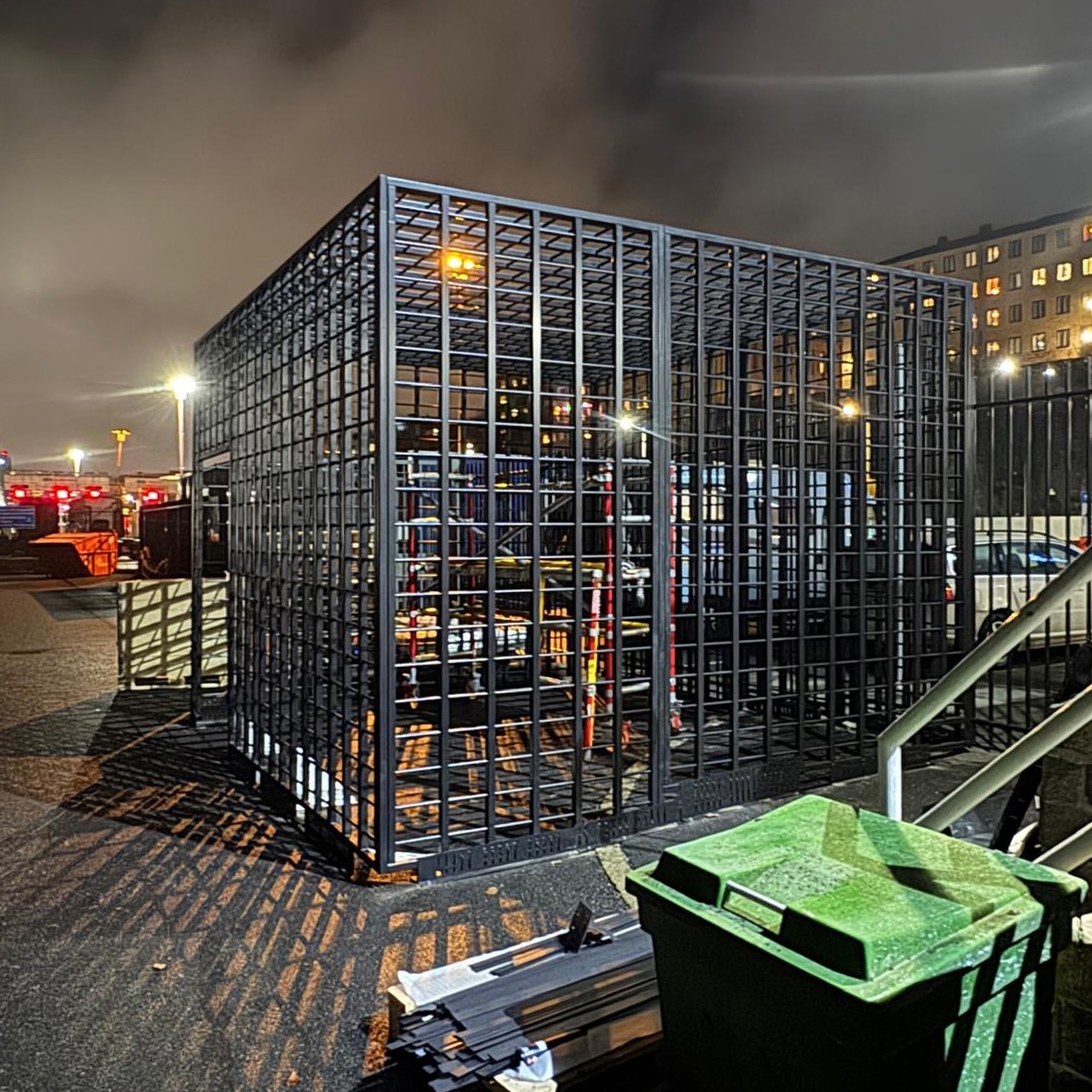
Outdoor switchgear cage
The project in Gothenburg involved the installation of a lattice cage with requirements for protection class 3. Placed outdoors, the cage is designed to meet corrosivity class C3, ensuring long-term durability in exposed environment. The design is mounted on adjustable profiles to compensate uneven ground, ensuring proper level and stability. All components are customized to meet the technical requirements and standards specified for the project.

Cage to Datacenter
Grid cage in a data center with high requirements for operational safety. The installation was carried out without hot work and without dust spreading, which is crucial in sensitive IT environments. The cage is designed so that it does not affect air flows or cooling systems, ensuring optimal temperature control. Modular and adjustable components make it possible to expand or adapt the cage in the future without compromising safety or environmental requirements.
Frequently Asked Questions & Answers
Lorem ipsum dolor sit amet, consisttetur adipiscing elite. Suspendisse varius enim in eros elementum tristique.
Protection class 3 (SK3) means that premises and products meet the requirements of high burglary protection and can withstand more intensive attempts to break in with tools such as pliers, screwdrivers and hand tools. For businesses handling cash, valuable items or sensitive information, SK3 is often a requirement, and this applies to stores, offices, warehouses and public buildings with a high level of security. By complying with SK3, the business ensures that it meets current security requirements and reduces the risk of burglary.
To meet the requirements of protection class 3, a business needs to use doors, windows, locks and fittings that are certified according to SK3 and that can withstand burglary attempts with hand tools and simpler power tools. It also means that the installation must be carried out correctly, since even certified products can lose their protective ability if assembled incorrectly. Combining the right products with proper installation ensures that the premises meet the security requirements that apply to operations with a high value of cash, goods or sensitive information.
RC4 stands for Resistenza Classe 4 and is a burglary protection rating that indicates how well a door, window or lock can withstand attempts to be broken up with tools. A product in RC4 can withstand more advanced burglary attempts with hand tools and some power tools for a certain period of time, making it suitable for both private and commercial premises where security requirements are high. RC4 is often used as the equivalent of Security Class 3 (SK3), but the classification is international and more detailed in terms of resistance to various types of attack.
NIS 1 and NIS 2 are EU directives aimed at raising security of information and network systems for critical infrastructure and critical services. NIS 1 was the first directive and set basic requirements for cybersecurity and incident reporting. NIS 2 is an updated and stricter version that includes more sectors, tightened safety requirements and clearer management responsibilities in operations that provide essential services or critical infrastructure, such as energy, transportation, finance and health.
Still have questions?
Click the button below to contact one of our experts!